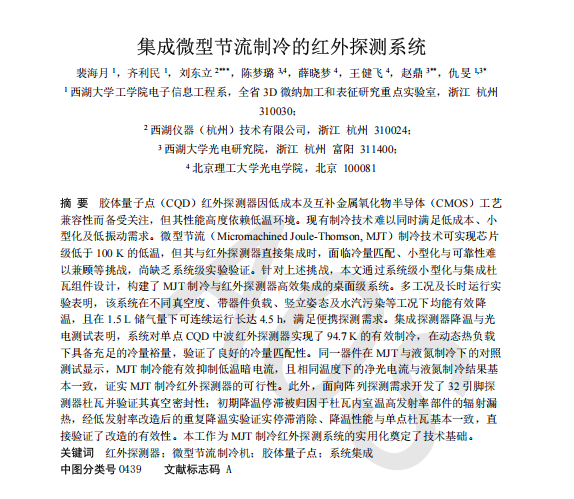
In portable infrared detection applications, colloidal quantum dot detectors require low-temperature operation to suppress dark current. Liquid nitrogen Dewars are inconvenient to store and transport, closed-cycle refrigeration systems suffer from vibration and structural complexity, and chip-level micromachined Joule-Thomson (MJT) cooling, despite its advantages of low cost, low vibration, and compactness, still lacks system-level verification for direct integration with detectors.
Through system-level miniaturization and integrated Dewar design, the research team developed a desktop-level MJT-cooled infrared detection system with overall dimensions of only 500 × 400 × 350 mm³. They established a detector-cooler integrated assembly coupling thermal, optical, electrical, and mechanical aspects, achieving efficient integration of MJT cooling chips with single-point and array infrared detectors. The system uses a 1.5 L/20 MPa small high-pressure gas cylinder and supports in-situ gas replenishment during low-temperature operation. Tests show that the system can effectively cool under various vacuum levels, loads, and postures, achieving continuous stable operation below 100 K for up to 4.5 h with 1.5 L gas storage. After integrating a HgTe colloidal quantum dot mid-wave infrared detector, the system achieved effective cooling at 94.7 K, with dark current suppressed effectively, and the net photocurrent was comparable to that obtained under liquid nitrogen cooling. A 32-pin Dewar developed for array detection passed vacuum sealing verification, and low-emissivity modification completely eliminated cooling stagnation.
Ph.D. student Haiyue Pei is the first author of the paper. The research findings have been published in the journal Acta Optica Sinica under the title "System Integration of Infrared Detectors with Micromachined Joule-Thomson Cooling."
paper link:https://www.opticsjournal.net/Articles/g261500/EarlyPosting